
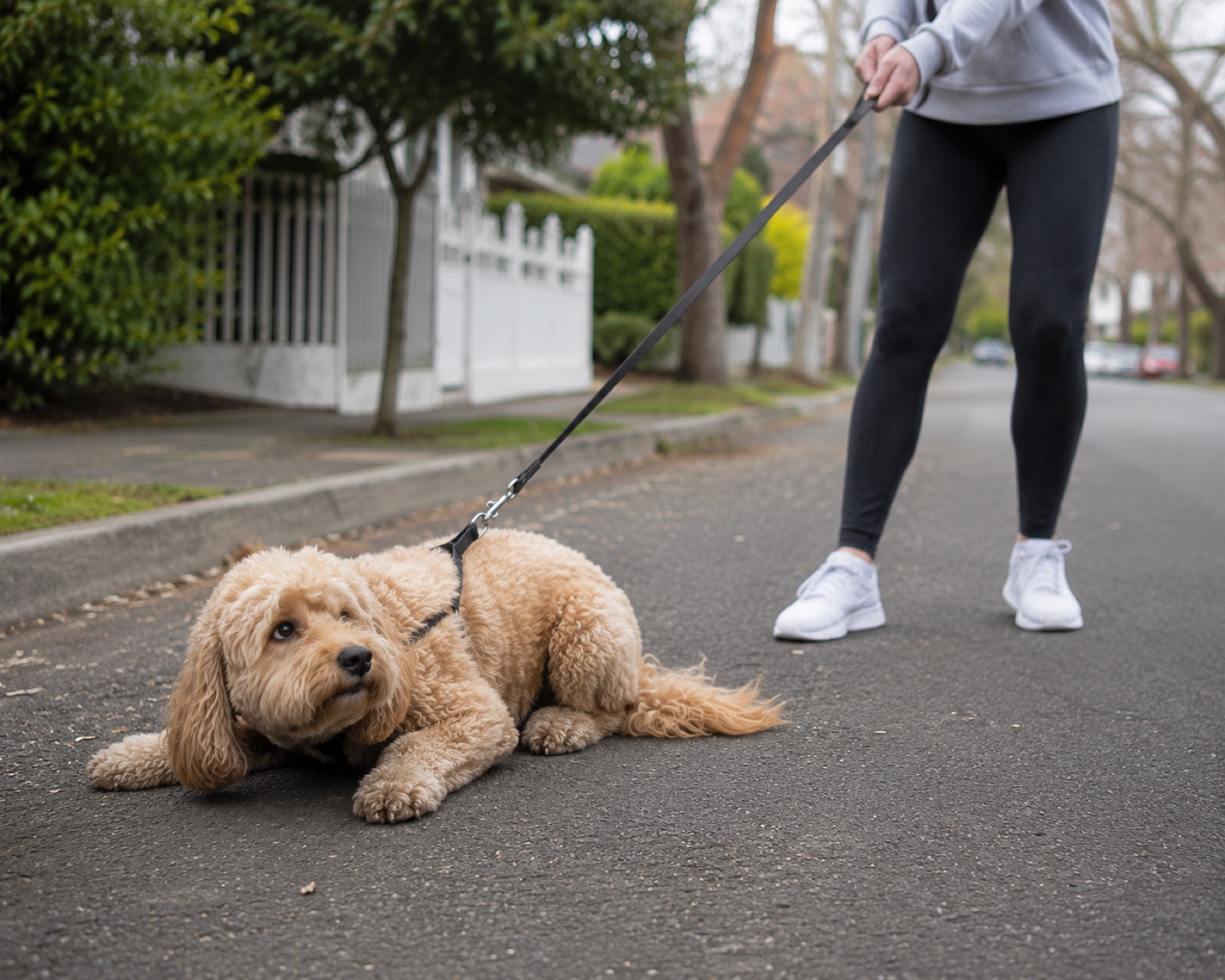
Fear-based reactivity is a scared dog rather than an aggressive one, barking and pulling backward away from things instead of toward them, and that distinction changes almost everything about how you work with it.
Angela brought Bodhi to me because she could barely get past the corner. Bodhi is a five-year-old Spoodle from Yarraville, and by the time Angela reached out, ten minutes was about as far as they could go before he was spooked by something. Wind. A banging door two houses away. A dog appearing too fast from behind a parked car. His response each time was to bark and pull backward, and Angela had spent years trying not to startle him, watching the environment for him, shrinking their world down to routes where less might happen.
That's not an aggressive dog. That's a scared one. The distinction sounds obvious, but it changes almost everything about how you work with the dog.
The tail tells you which kind of reactive you're dealing with
Not all reactive dogs are the same, and treating them as if they are produces inconsistent results at best. The body language tells you what's underneath the bark.
An offensive reactive dog makes itself big. Tail up, chest forward, weight loaded onto the front feet, ears hard forward. The bark is loud, sustained, and directed. This dog has decided the trigger is a threat to be dealt with, and the aggression is intentional. It is not scared. It is asserting something.
A fear-reactive dog makes itself small. Tail low or tucked, body weight back or crouching, eyes wide and darting. The bark is there, but it comes with a lot of backward movement, circling, and looking for an exit. Bodhi would bark at a trigger but his tail would be down and he would try to put space between himself and whatever scared him. His ears would go back. He would look enormous to a stranger but if you watched the tail, you were reading a very different story.
If Bodhi barked and his tail was low, I wouldn't correct him for the bark. That bark was him processing something uncertain. Correcting uncertainty barking tells the dog to suppress the signal, not deal with the fear. The tail going up, the chest coming forward, the body hardening into offensive territory: that is when correction is appropriate, because that is a different decision the dog is making.
Angela needed to learn to read the difference quickly and at distance. Once she could, she stopped reacting to the wrong moment.
What raises a fearful dog's waterline faster than anything
Bodhi's baseline arousal was high before they'd left the street. He was a dog who spent a lot of time scanning his environment, alert to things Angela couldn't hear or see yet. Wind added to it, because wind carries unpredictable sounds and smells from directions he couldn't locate. Rainy days were harder than dry ones. Late afternoon was harder than morning, when the world was quieter and his brain hadn't yet accumulated the day's load.
The walks themselves had been raising his baseline for years. Angela had been taking him to environments she thought would help him, letting him sniff and move and get used to things. The intention was right, but the execution was pitched above what his nervous system could absorb. He arrived home with more in his tank than he'd left with. The next walk started higher. Over months, the baseline had crept up to the point where almost anything could push him over.
Decompression is the word I kept coming back to with Angela. After any effort, Bodhi needed time to fully come back down before anything else asked something of him. On harder days, that meant staying closer to home for the next outing, not ranging further to "prove" he could handle it. Not every session is a progress session. Sometimes a session that ends with him more settled than he arrived is the best result you can get.
Advocating for a dog who can't advocate for himself
One of the patterns I see in fear-reactive dogs is that their owners, understandably, try to manage the dog's environment on their behalf rather than teach the dog to trust that the owner has it covered. Angela was doing that. She was scanning everything first, tensing before Bodhi reacted, trying to pre-empt the stimulus before he noticed it. He read that tension in her as confirmation that there was, in fact, something worth worrying about.
The work was partly about Angela holding a calmer posture so Bodhi got a different read. And partly about her learning to physically advocate for him when they encountered another dog: position herself between Bodhi and the trigger, bicep-curl hold so the leash was steady without jerking, and let him know through her body that she had it and he didn't need to be on the front line of it.
I used Murphy, my Labrador, in Bodhi's sessions. He is a certified assistance dog and he has the kind of body language that fear-reactive dogs read as non-threatening: low tail when relaxed, no hard stare, slow movements. Angela watched how Bodhi processed a calm presence versus an intense one. That comparison does a lot of teaching fast.
What changed in four sessions
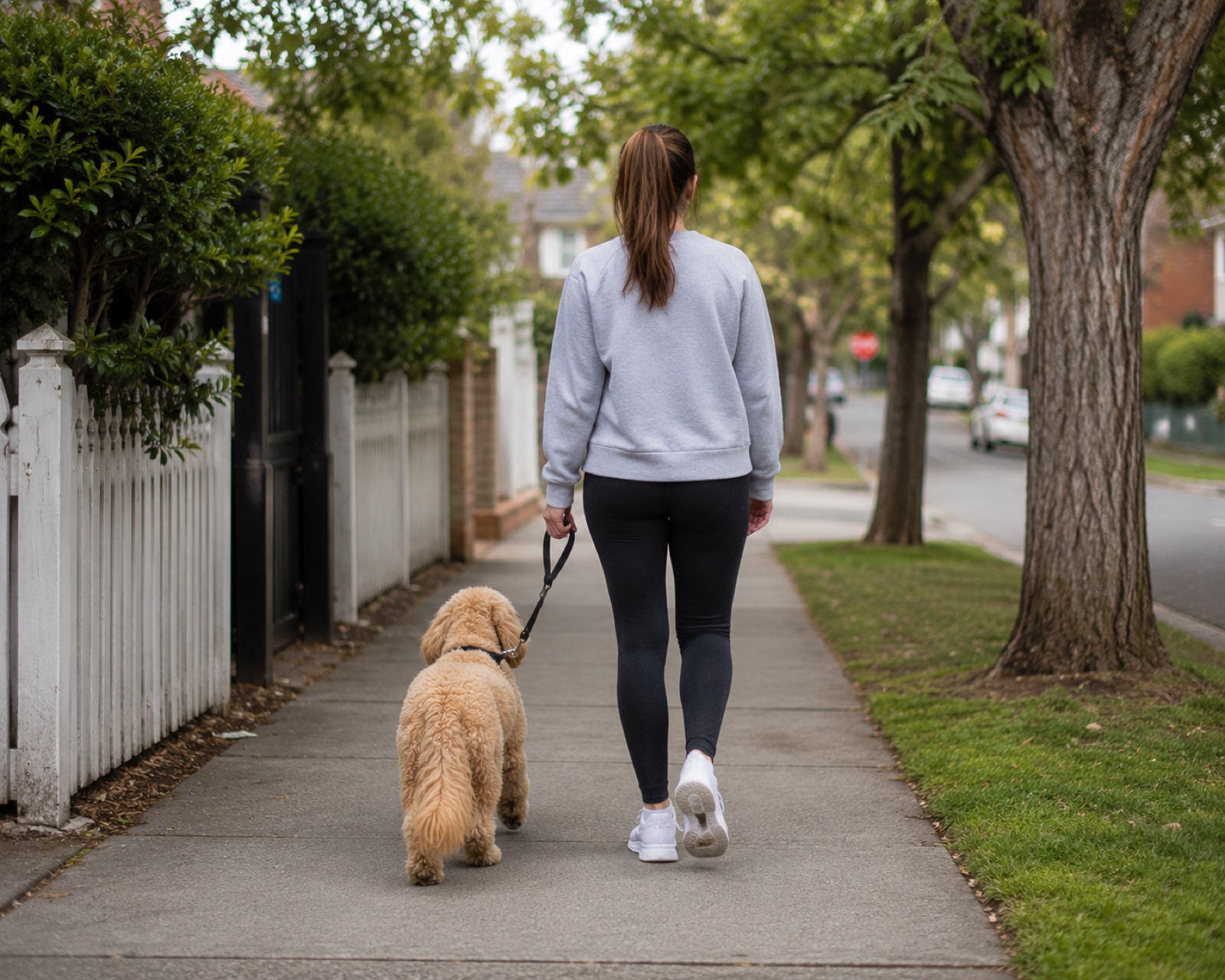
By the end of the program, Angela wrote something I get some version of regularly. "Bodhi now trusts that I've got him, and that's changed everything for us. I finally have a walking buddy."
That was not a dog who had stopped noticing triggers. He still noticed. He still reacted sometimes. What changed was the speed of recovery and the gap before the reaction. Where ten minutes used to be the ceiling, they were walking for thirty minutes or more. The world had got bigger, not because it had become less scary, but because Bodhi had more confidence that Angela was reading it with him rather than after him.
There was also a back injury mid-program that paused the work for a week. Bodhi recovered, and so did the progress. One of the things I watch for in fearful dogs is whether setbacks compound. For Bodhi, they didn't. The work was solid enough to pick back up without losing ground.
The session where I saw the biggest shift was the one where they walked past the house with the dog that had always set Bodhi off, the one he'd had a specific pattern of reacting to on a particular street. He glanced at it. Angela kept walking at an even pace. He followed her. She looked down and he was already disengaged, sniffing the grass three steps past the house.
That is the shift. Not the absence of fear. The presence of trust.
If your dog sounds like Bodhi, the private training program is built for this. The first session is mostly me watching your dog's body language and teaching you to read what it's already saying. From there, the work gets specific.