
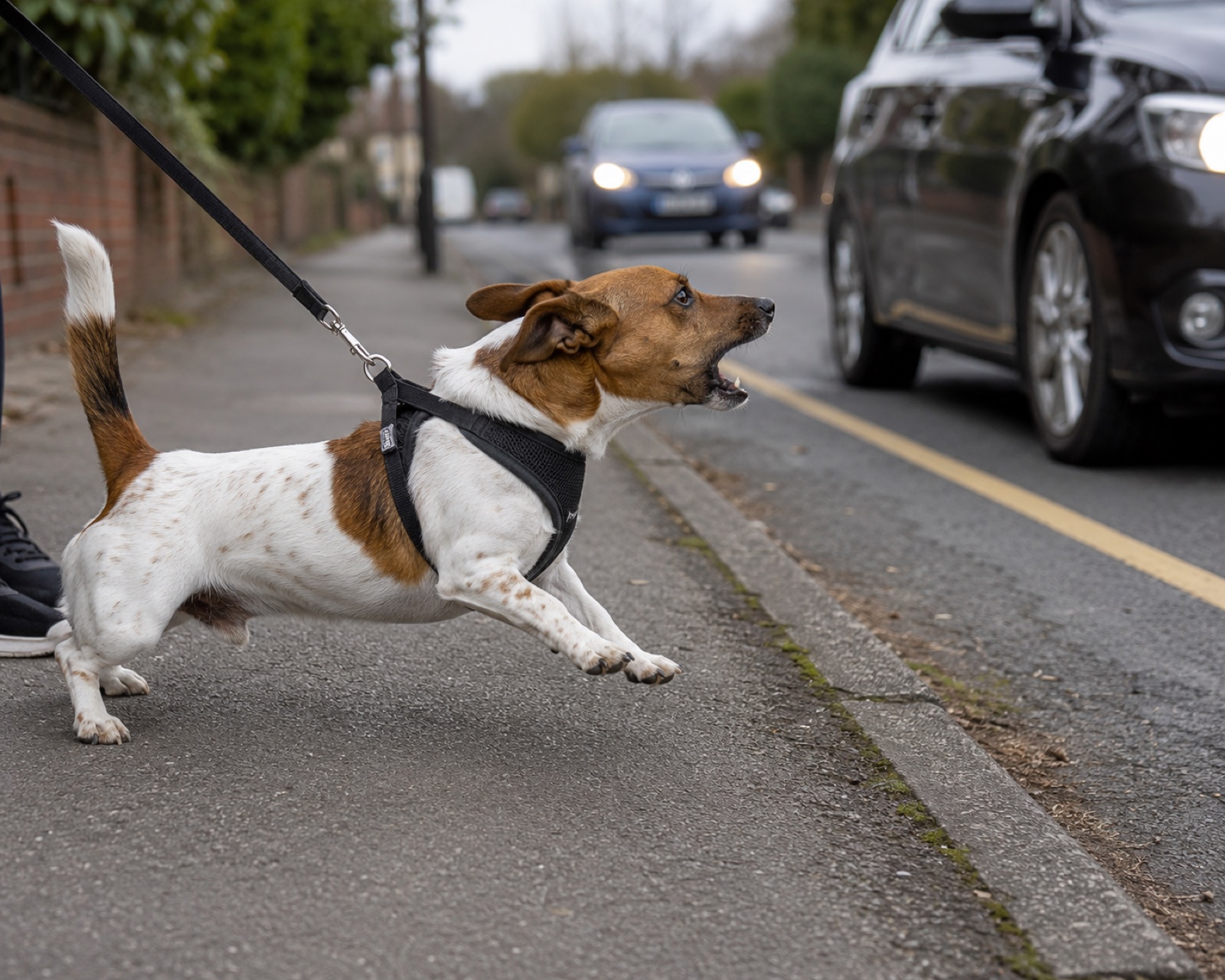
Dogs lose it at passing cars because their arousal is already near the top before the first car appears, often building from the moment the gear comes out at home, so the car only tips a waterline that was rising all along.
Benzi is a Dachshund cross Jack Russell from Heidelberg. When Sajee and Shelly brought him to me, cars were setting him off on every outing. Not just the occasional passing truck. Any car on any street. The reaction was volcanic: lunging at the end of the lead, barking continuously, needing several minutes to come back down. Shelly described the walks as transferring Benzi's anxiety directly into her own body. She would spend the whole time scanning ahead for traffic, tightening before he did, dreading the walk before it started.
That anxiety loop between owner and dog is one of the most common things I see, and it's self-reinforcing. The dog reads tension in the handler, the handler reads reaction in the dog, and both arrive at the next walk already partway up the waterline.
The arousal starts before the walk does
One of the first things I noticed with Benzi was that his arousal build-up was not beginning at the first car he saw. It was beginning at the cupboard where the gear was stored. The moment Sajee reached for the lead, Benzi was already on his way up. By the time they were out the front door, the waterline was close to the top. The first car they passed tipped it over.
This is a very common pattern in reactive dogs and it is often invisible to owners because the actual reaction happens outside, during the walk. The cause is already in motion inside the house.
Afternoons were significantly worse than mornings. That pattern is useful data. An afternoon walk has the weight of the whole day on it: everything that raised the waterline since breakfast. Morning walks start lower. If a dog is consistently worse at a specific time of day, the question to ask is what has been adding to their arousal since they woke up.
What we aimed for in the first three sessions
I told Sajee and Shelly early in the program that Benzi would still lunge and bark at cars. That was expected and not the measure of progress. The measure was how fast he came back down. An explosion that takes two minutes to recover from is meaningfully different from one that takes thirty seconds, even if the behaviour at the peak looked the same from the outside. We were working on the recovery first. The reactions would reduce as the waterline came down. The recovery speed tells you the waterline is moving.
I used the volcano image a lot with this case. Every dog has a resting state and a point where they overflow. Training is not about sealing the volcano. It is about how high the baseline sits, and how much it takes to reach the rim. A dog with a lower resting waterline needs a bigger trigger, or a longer sequence of smaller triggers, to overflow. A dog with a high resting waterline can be set off by something the owner would never notice.
Benzi was running at high tide most of the day. The car wasn't the problem. The car was just the last thing before the top.
Reading the recovery instead of the reaction
Owners of reactive dogs spend most of their focus on the moment of reaction and very little on what comes after it. That's understandable. The reaction is loud and physical and hard to ignore. But the recovery is where the actual information is.
De-escalation signals are specific. Ears going low or turning outward instead of tracking forward. Eyes softening, the hard stare breaking. A look away from the trigger. Body weight settling back. A slow blink. A sniff at the ground. Any of these is the water dropping. That is the moment to say "ready" and invite PLAY. If the dog snaps into engagement, the game is back on. If it doesn't, say "finish" and wait for the next signal.
In one of Benzi's sessions, he spotted a car, started his usual escalation, and then at a moment where I would have expected the lunge, he glanced at the car and turned back to engage with PLAY instead. He had made a decision: the car was there, and he chose the game over the reaction.
"He made an amazing choice here at 0:01. He spotted the trigger, then decided to re-engage with PLAY."
That kind of moment does not come from the dog learning that cars are not threatening. It comes from the dog's waterline sitting low enough that the car doesn't reach the rim. The game is more interesting than the reaction when the dog isn't already primed.
Shelly's message in April
About two months into the program, Shelly sent me a message that I have since sent to other clients when they're in the hard middle section of a program and wondering if it's working. It said: "I said to Sajee yesterday, it's actually fun taking him for a walk now. I feel like I'm not having to be so hyper stressed and trying to predict the movement of cars myself. Felt like his anxiety was fed through to me. He was an absolute joy."
She followed up a few days later with video of him on a long lead through a grassy area that had previously been a reliable trigger location. He was nose-down in the grass, uninterested in the road running alongside. "He couldn't care less. He was more interested in the smells."
That is the end state this work is aiming for. Not a dog who has learned to suppress his reaction through obedience. A dog whose waterline is low enough that the trigger doesn't reach it. The walk is just a walk again. The grass is more interesting than the car.
Sajee put it simply at the end of the program: "You've honestly changed the game with Benzi."
If your dog has a specific trigger that sets off a predictable pattern, whether cars, bikes, other dogs, or anything else, the private training program starts by working out what is maintaining the baseline, not just what tips it over. That is usually where the real change is.