
Alert barking that never stops is usually a dog who has taken on the job of reporting every sound to the household, often paired with a behaviour the owners have accidentally been rewarding.
Figgy is a Maltese x Poodle from Kingsville. Erin and Sudung counted six or seven alert barks on a typical day. He was barking at sounds they couldn't hear, noises outside the fence line, things that apparently registered to him but produced nothing visible to his owners. He was not an anxious dog in a depressed, withdrawn way. He was alert, sharp, and determined to report everything to the household whether the household wanted the report or not.
The other presenting issue was crate resistance. Figgy would carry on in the crate, sometimes for extended stretches, and Erin would eventually let him out to stop the noise. She knew, intellectually, that she was rewarding the demanding behaviour. The difficulty was that it had been working for so long, from Figgy's perspective, that she was now up against a well-established pattern.
What alert barking actually is
Sound-reactive dogs are monitoring their environment continuously. Every noise that falls outside the category of "known, predictable, and safe" gets flagged. The bark is the flag. The problem is that a dog running this level of vigilance never properly switches off, which means the baseline arousal stays elevated, which means it takes less and less to trigger a bark. The alert becomes hair-trigger because the dog is always partway up the waterline already.
This is why the pattern tends to get worse, not better, if you leave it alone. It is not a quirk to habituate out of. It is a nervous system running above the range it should be running at, and the behaviour is the signal of that.
The other thing happening in Figgy's case was that the barking had a reward history. He barked, Erin let him out. He barked, someone went to check what was happening. He barked, the attention arrived. He had no incentive to stop. The behaviour was working for him.
Why CALM was the lever for Figgy
Figgy's problem was rooted in a dog who never properly switched off, so for him the crate work was the lever, the part of the program that, once Erin held it consistently, changed the household. For a different dog with a different gap, the lever sits somewhere else. The crate work is also the part owners find hardest to hold. The rule is simple: a dog in CALM only comes out when it is settled. Not when it stops barking for a few seconds and then starts again. Settled. Still. Not demanding.
An adult dog can hold three hours in a crate without welfare concern. Figgy was an adult dog. The duration was not the issue. The consistency was. Every time the demanding behaviour got a response, it reinforced the pattern. Once the pattern stopped producing a response, it had to extinguish. That is not complicated, but it is hard in the moment, because it tends to get louder before it gets quieter.
"He knows if he barks he will be let out. Always only let him out when he's settled. He's an adult so he can quite easily hold."
Erin was disciplined about it. Within the first few weeks, Figgy was settling faster in the crate and the alert barks at home were dropping. He started taking himself into the crate at the end of a cycle without being put there. That is a dog who has learned that the crate is where rest happens, not where demanding gets results.
Reducing the input that keeps the system on alert
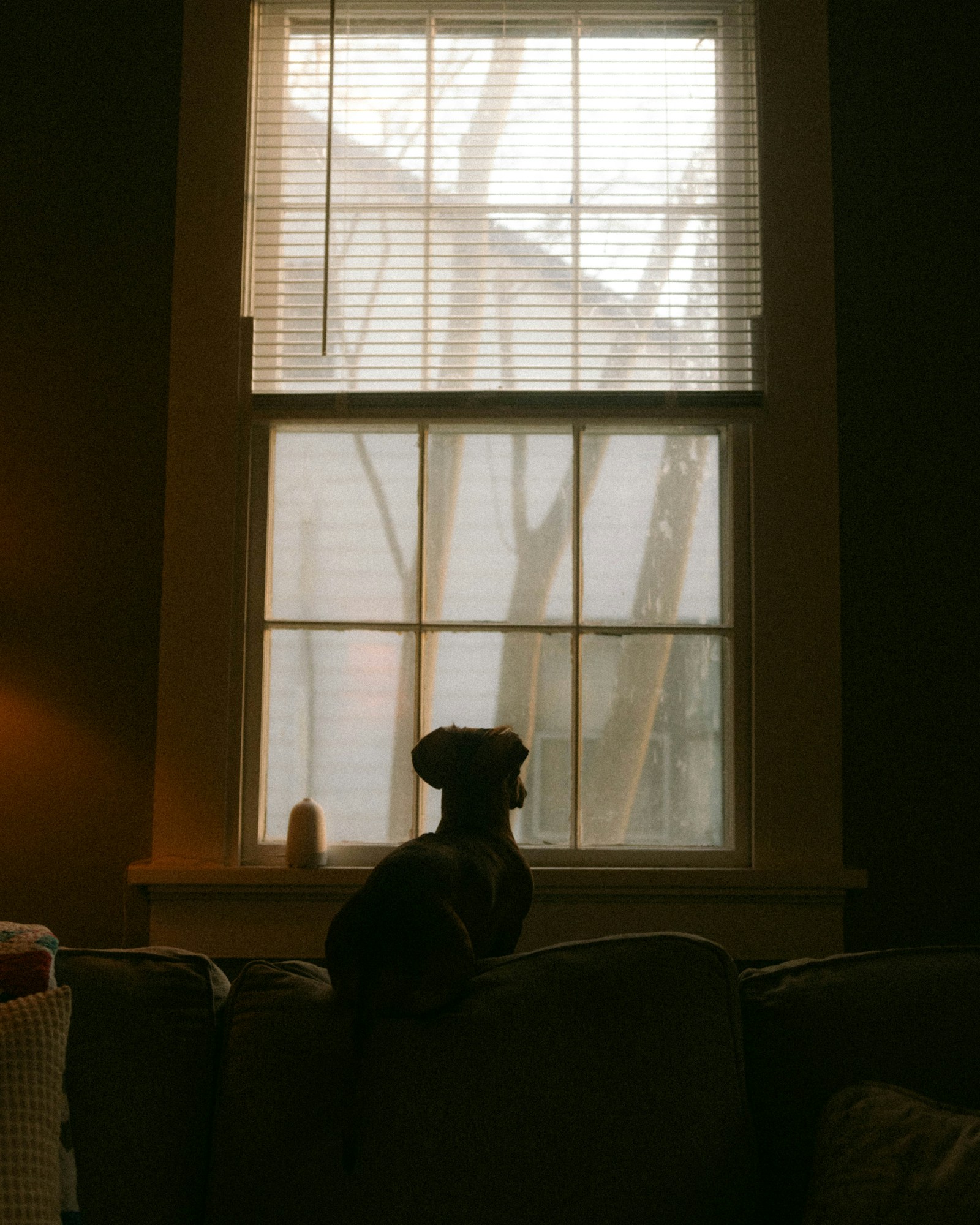
Part of the alert barking problem was sensory: Figgy had a view of the street from the house and was using it constantly. He was monitoring everything that moved. One of my recommendations was to reduce that access when he was out of the crate. Close the windows that gave him the patrol view. Give him less to manage. A dog who is constantly patrolling from inside the house is not resting, regardless of whether they're lying down while they do it.
Erin asked whether fresh air was more important than closing the window. My answer was direct: I'd rather no barking than fresh air. The fresh air could come back once the pattern was broken and the waterline was lower. Until then, reducing inputs is not deprivation. It is giving the nervous system a chance to drop.
We also worked on a structured desensitisation exercise for the alert barking itself. An interrupter was introduced at the moment of escalation, paired with redirection into PLAY. The dog learns that the sound is an opportunity to engage with the handler, not a reason to mobilise the household.
What Sudung wrote in his Google review
A few months after finishing the program, Sudung left a review that described what had actually changed: "Diona magically changed Figgy to a more connected dog by training us how to read him." The word he used was connected. Not obedient. Not quiet. Connected.
That is the shift. A dog who is alert-barking at frequencies the humans can't detect is operating in a separate world from its owners. The training did not make Figgy less sensitive to noise. It made him more oriented toward his people as the source of information about what those noises meant. When you are the reference point, the noise loses its automatic urgency. He could check in with Erin and Sudung rather than appointing himself the sole judge of whether the fence-knock was a threat.
By the time Erin sent her last update, she was getting comments from visitors about how settled Figgy was. He was taking himself to his crate at the end of a cycle. He was whining in the crate for under three minutes before settling. Erin put it this way: "I'm getting taught more self-discipline than he is."
That is often exactly right. The dog regulates when the human holds the structure. If your dog has a barking pattern that seems disconnected from what you can see or hear, the private training program starts with what's running underneath it.