Reading your dog means watching the body before the bark: the tail position, the ear set, and the small tells that show a reaction building while there is still time to change it.
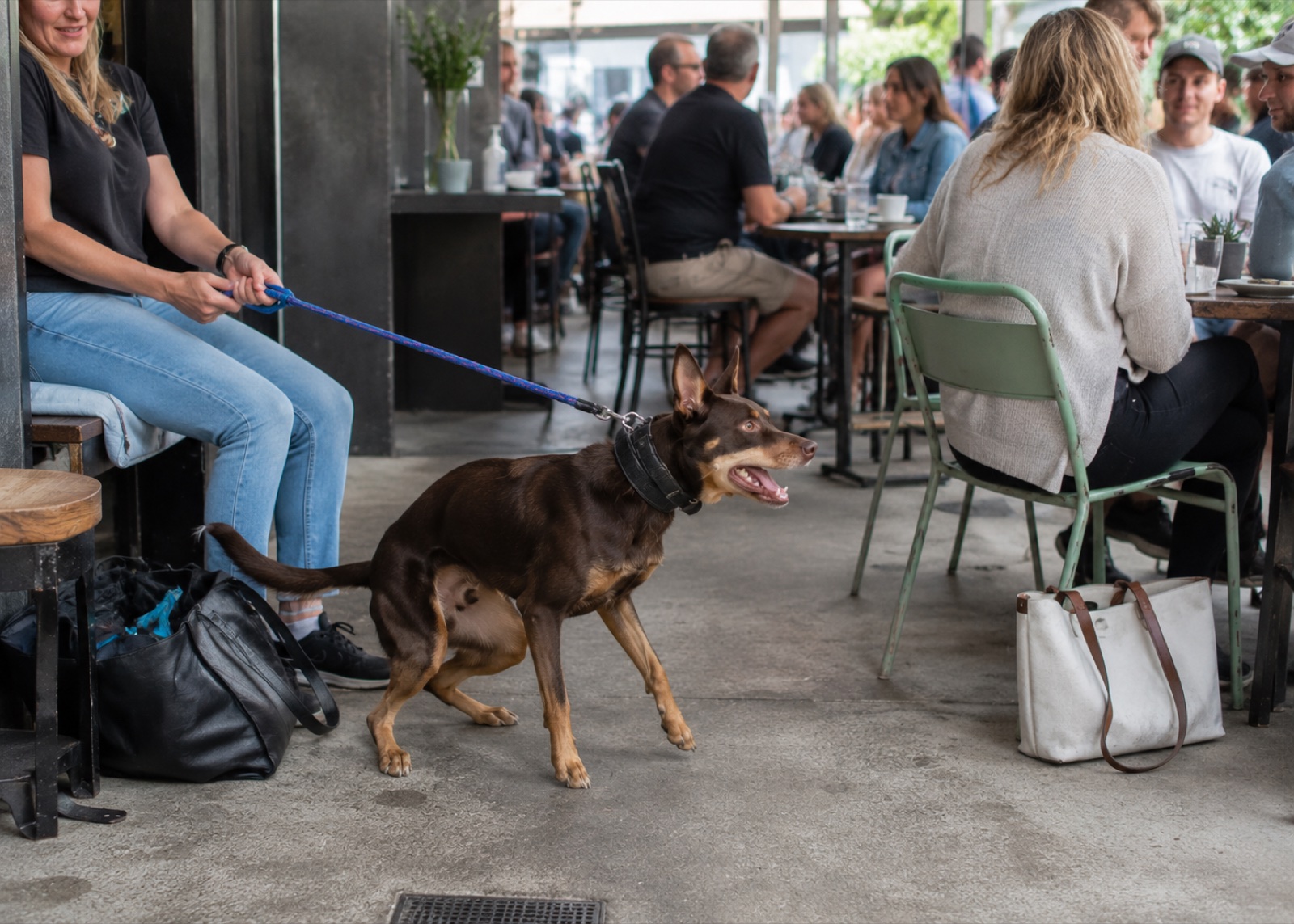
Tayla and Michael came to me with Gibbs, a Kelpie cross from Yarraville, because he was barking at everything in the backyard, reactively lunging at other dogs on walks, and marking obsessively at every surface they passed. He was a young dog with a high-drive breed behind him and a household that had not yet found a structure that held him.
The behavioural picture was not unusual. What was unusual was how fast Tayla picked up body language reading once she started looking for it. By the third session she was catching micro-signals most owners miss for months. That speed is not about intelligence. It is about knowing specifically what to watch, and having footage to practise on.
The tail is not what most people think it is
Most owners watch a wagging tail and conclude the dog is friendly or happy. The tail is actually one of the most information-rich parts of the dog's body, and whether it's wagging tells you almost nothing. What the tail is doing, in terms of position, stiffness, and which part is moving, tells you a great deal.
Gibbs had a specific tell. When he went into what I call a stare or near-point, the tip of his tail would start flicking. Not a whole-tail wag. Just the tip. That tip movement, with the rest of the tail stiff, was the sign of a dog entering a predatory chain: locate, orient, stalk. It was the signal that the next few seconds would either produce a redirect or a lunge.
"He went into STARE, almost POINT. You can see the flicking on the tail. Only the tip is moving. Not a whole-tail wag."
Once Tayla could see that tip movement, she had a two-second window. That is enough. Two seconds is enough to change direction, put a foot on the lead, or drop into PLAY before the chain advanced. On the lunge, you are responding to history. Two seconds before it, you are responding to a signal.
What the ear position tells you that the tail doesn't
Ears tracking forward and staying forward, not moving, not releasing: that is the signal of increasing fixation. When the ears are tracking forward, the dog's attention is on the trigger and not on you. When the ears soften, angle back slightly, or stop tracking: the dog has disengaged from the trigger, even momentarily. That disengagement is the window.
With Gibbs on walks, Michael and Tayla were doing their video feedback in a way that let me timestamp what I was seeing. I would write back: at this point his ears went up, at this point they're still up, at this point they tracked back, at this point he glanced at Michael and that was the moment to say "ready." They were watching Gibbs from inside the experience of walking him. The footage let me watch from outside it, and what I could see was usually several seconds ahead of what they were catching in the moment.
After a few weeks of feedback like that, Tayla stopped needing the timestamps. She was catching it in real time.
The difference between demand barking and trigger barking
Gibbs had two distinct barking patterns, and they were not the same problem. His trigger barking on walks was arousal-based: he saw a dog, the waterline rose, he reacted. His demand barking at home was something different: he was barking at sounds outside, at possums, at the doorbell, at Tayla going out of the room. That pattern was attention-seeking. He was barking because barking had produced results in the past.
Treating both the same way would have been wrong. The trigger reactivity needed waterline work: lower the baseline, improve recovery speed, build the handler's ability to read and interrupt the escalation. The demand barking needed a simple rule change: barking does not produce attention. Ever. Not even a "no." Not even a glance. When the demand behaviour stops producing results, it stops.
For the worst of the demand barking, the instances where Gibbs was reacting to sounds from outside the fence at high intensity, an interrupter was introduced at the peak moment. Between triggers, when he made a good decision: big party. The ratio matters. If the only feedback is interruption, the dog becomes shut down. The goal is interruption at the wrong choice and genuine reward at the right one.
The moment the training had taken hold
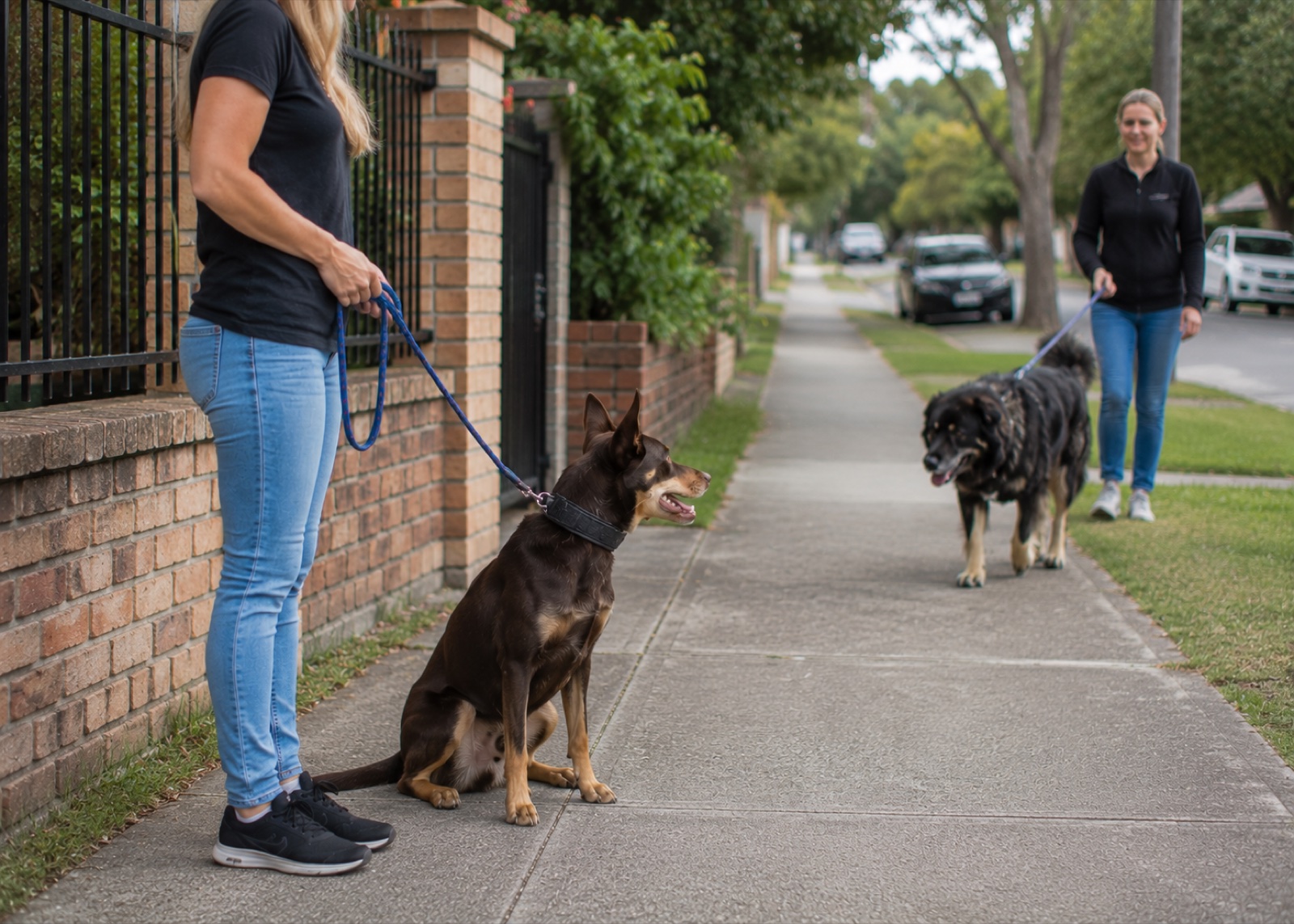
Tayla sent me a message that I have shared with other clients when they are in the middle and wondering if it is working. She wrote: "We had an almost aggressive dog walk past us when we were almost back to our gate. I turned him towards the gate with a left turn and kept him in handbrake until the dog passed. His ears went down and back almost immediately and boy oh boy I praised and praised."
The next sentence is the one I remember: "He really chose not to react to quite a high aroused dog, in a position where we couldn't really move away. Just faced away. He looked up at me with tail wagging proud as punch."
That is a dog who has learned that his owner reads the environment and that he doesn't need to do it himself. He was in a position that would have previously produced a lunge. He chose to look to Tayla instead. The trust that built between them over the program was the reason he made that choice. The body language reading was the skill that let Tayla hold her side of it.
A few months later, Tayla sent an unprompted update: "We have had the BEST times with Gibbs today. He's been the loosest-leashed boy in town."
If you want to build the skill of reading your own dog's body language in real time, not just knowing what the textbook says but being able to catch the ear movement and the tail tip and the weight shift in the middle of a walk: that is what the program teaches. Private training is where we do that.