
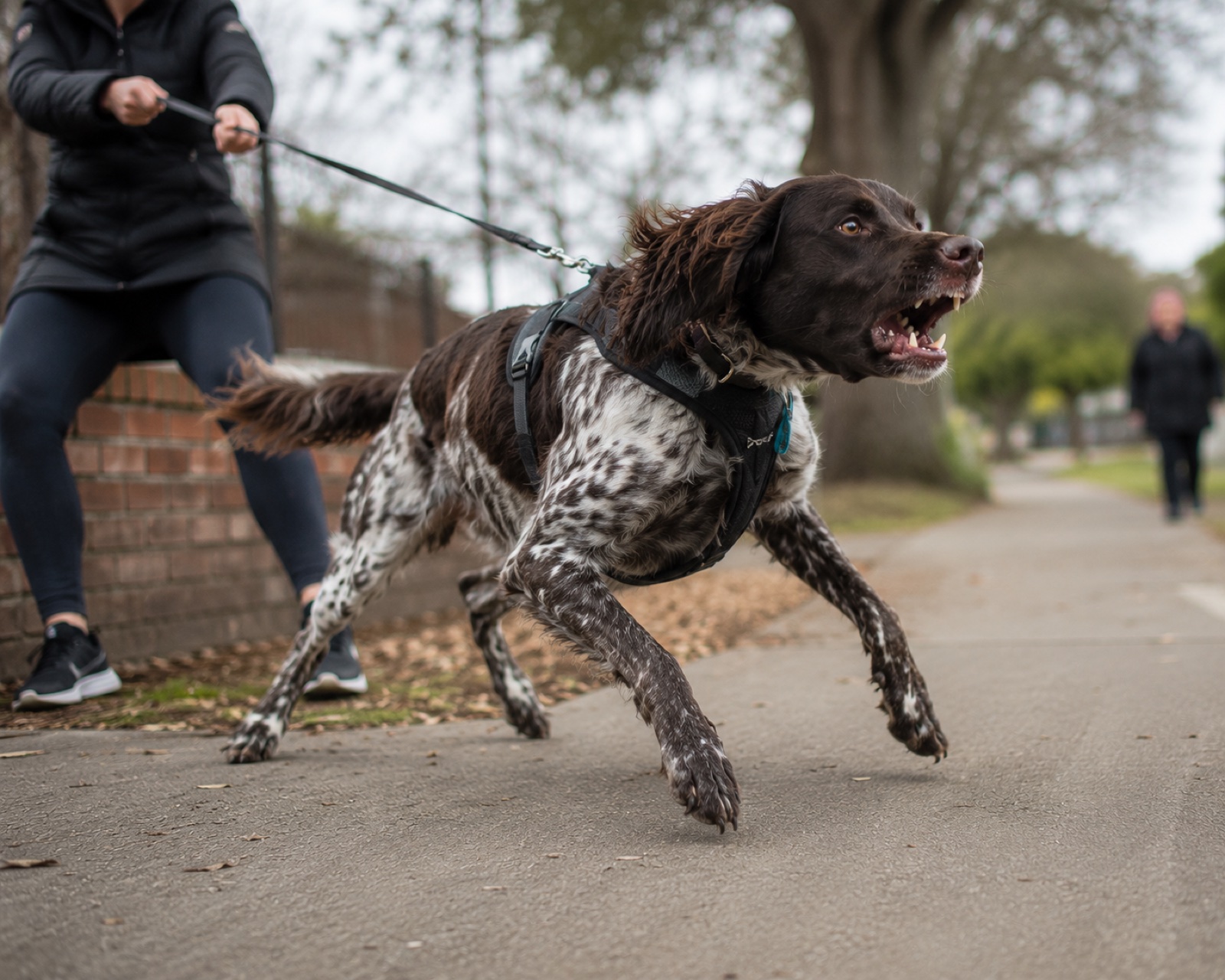
A teenage dog who has to say hello to everyone is showing FOMO reactivity, barking and pulling toward every dog and person not out of aggression but because he wants access to them.
Herne is a Large Munsterlander from Thornbury. Sophie and Tassia brought him to me because, in their words, he would lose his hearing entirely the moment a dog or person appeared in his line of sight. He would bark, pull, lunge toward the trigger, and the only thing he seemed to want was access to it. He was not reactive in the aggressive sense. He was reactive in the FOMO sense: every other dog was a potential friend and he was being denied the meeting.
This is a very different problem from fear-based reactivity, and it is also a very different problem from offensive reactivity. But it still produces the same outcome on the lead: a dog who is not listening to you and who is pulling hard toward something. The behaviour looks similar from the outside. The cause is different, and so is the approach.
Why FOMO reactivity is still reactivity
Owners of social, friendly dogs often resist the word "reactive" because the dog isn't trying to attack anyone. But a dog whose arousal spikes the moment it spots another dog, whose attention leaves the handler completely, whose body orients entirely toward the trigger: that is a reactive pattern. The trigger is exciting rather than threatening. The loss of regulation is the same.
Herne was also barking and biting at Sophie and Tassia's ankles during free time at home, demanding engagement, running to the fence to bark at every sound. He lived at the top of his waterline most of the day. The FOMO behaviour on walks was not a separate issue from the demand barking at home. They were the same underlying pattern: a dog who had not learned that waiting, resting, and being near his people without requiring their direct engagement was a valid state.
I said to Sophie and Tassia: typical teenager behaviour. The impulse control that comes with maturity had not arrived yet.
The bow-and-arrow problem
One of the most common mistakes I see owners make with a FOMO dog, in the moment when a trigger appears during PLAY, is to grab and tug the lead. It feels like you're restraining the dog. What you're actually doing is loading the spring. You pull back, the dog pulls forward, the tension validates the excitement. When you release, or when the lead slips, the dog fires out harder than if you'd never pulled.
The instruction I gave Sophie was specific: foot on the lead, not hands on it. Stand on it where it first touches the ground. The dog can still move around, but the range is short, and the anchor is in your foot rather than in a tug. The lead goes slack when the dog is near your feet. It only goes taut if the dog tries to lunge. There is no pulling. There is no spring being loaded. There is just a stop.
"When you spot a trigger during PLAY, make sure you're putting your foot on the lead, not tugging it. When we tug, we create a 'bow-and-arrow effect' which validates his excitement even more."
The next instruction was harder: wait. Do nothing. No eye contact with the dog, no voice, no engagement. Wait until the dog's body comes back down. Ears stop tracking the trigger. Weight settles. The dog glances up at you. That is the signal. You say "ready" and the game picks up again. The dog has just learned that de-escalation is the path back to the thing it actually wants.
What the initial consult homework revealed
Sophie and Tassia had two weeks of homework between the initial consultation and their first formal session. I do not always get meaningful feedback from a two-week gap, especially early in a program. The message Sophie sent the night before their first session was the kind I remember: "It's already working wonders."
Two weeks. No formal sessions yet. Just the cycle structure, the PLAY adjustments, and the crate shift. That is not unusual. The fastest changes I see are often in the two weeks after the initial consultation, before the formal program has started. The structure does a large portion of the work on its own if it is applied consistently. Herne walked himself into his crate at the end of a cycle during that first fortnight. That is a dog who is finding the rest period useful rather than fighting it.
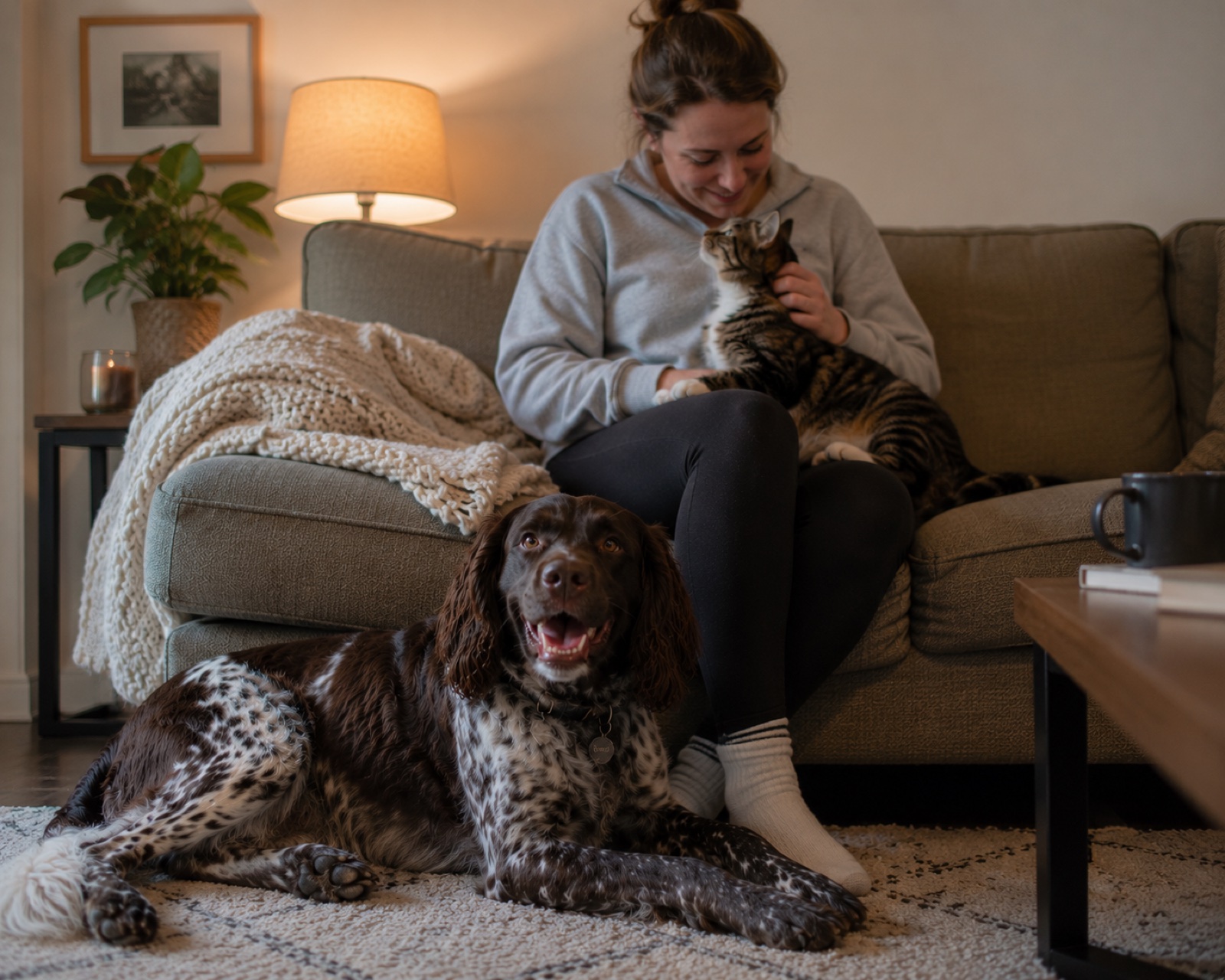
Tassia sent a message early in the program: "Overall, Herne is doing so much better with this new routine and set-up." The cat tension at home was still a work in progress. The walks were already substantially different.
The goal for this kind of dog
With a FOMO dog, I am not trying to make them indifferent to other dogs. That is not a realistic or even desirable outcome. A friendly, social dog who notices other dogs and finds them interesting is fine. The goal is a dog who notices the trigger, does not escalate toward it, and brings their attention back to their handler within a reasonable time. That is the whole task.
Recovery speed, not no reaction. Herne barked at a passing dog and came back down within twenty seconds: that is progress. He barked at a passing dog and was still oriented toward it three minutes later: that is the waterline sitting too high. The measure is how fast the drop happens, not whether the reaction happened at all.
At this stage of training, Sophie and Tassia were told clearly: he will bark and lunge. That is expected. The question is how fast he comes back down.
Sophie and Tassia signed up for the 4-week program after the initial consultation. By the end of it, the expectation I set for them is clear: Herne will be non-reactive, and he will walk on a loose leash. Not better. Not improved. Non-reactive, on a loose leash, consistently. That is the bar the program is built to reach.
If your dog sounds like Herne, young, social, and completely unable to filter the environment, the private training program is built for exactly this. The structure that changes it is the same whether the dog is scared or excited at triggers. The approach within that structure shifts based on which one it is.