
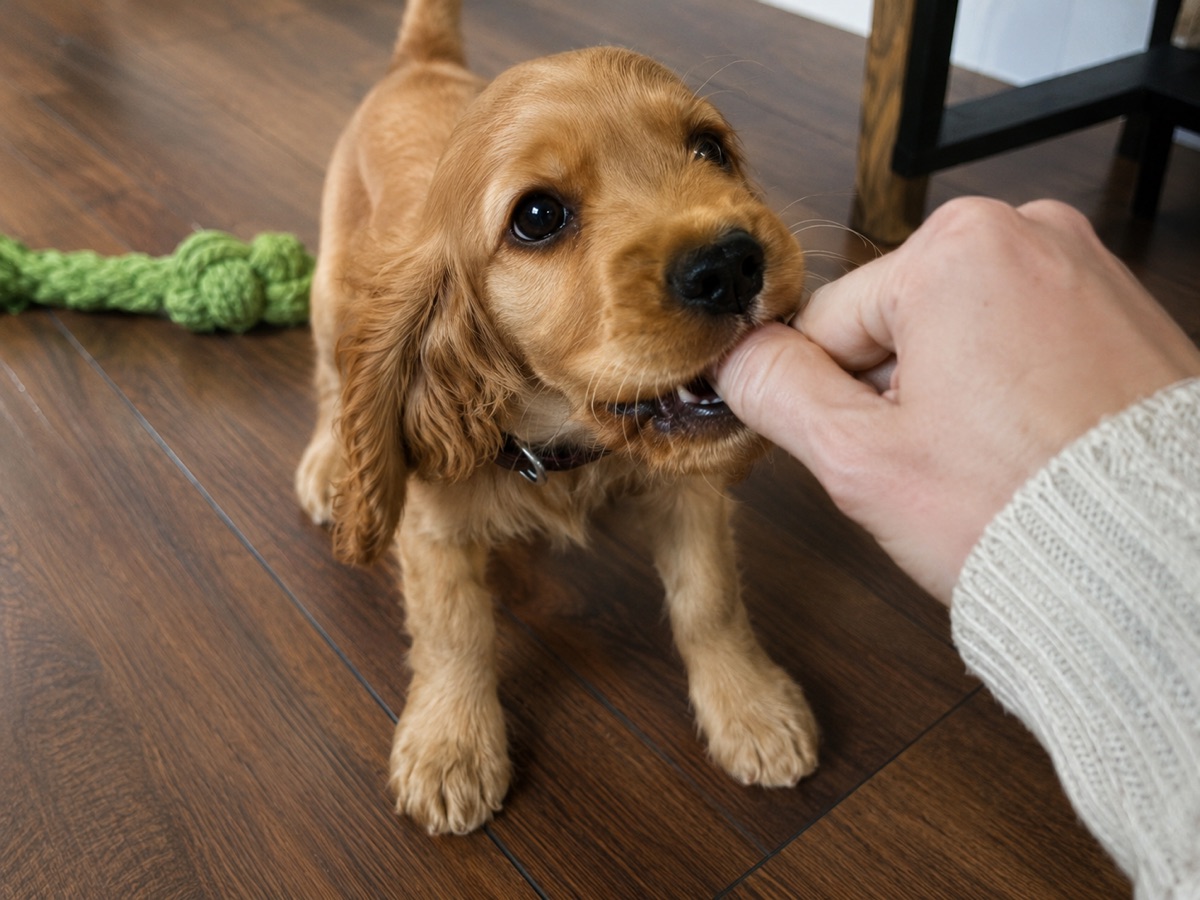
Walking your puppy more makes things worse because the extra activity overtires it, and an overtired puppy sleeps less, bites harder, and listens to you less. The picture most new owners have is simple. A tired puppy is a good puppy, so walk it more. By the time the family calls me, the puppy is sleeping less, biting harder, ignoring more, and the household is exhausted. The walks are not working. The walks are part of why.
The mistake most new owners make
You bring the puppy home. The first week is hard. Someone tells you to walk it more, that the zoomies and the biting will stop once you wear them out. So you add walks. Twenty minutes, then thirty, then a morning and an evening. The puppy sleeps better that first night, and you think the answer is more.
By week three the puppy is harder to settle, not easier. Bites have got sharper. The puppy ignores you more. You add another walk. Things get worse.
This is the most common path to a reactive adolescent dog I see. Not bad genes. Not a "high energy" puppy. A nervous system that has been pushed past its capacity, every day, by people doing what they were told would help.
Why a young puppy cannot be tired out by walking
A puppy's brain regulates closer to a toddler's than to an adult dog's. They get overtired before they get tired. Past a certain point of arousal, more activity does not drain the tank. It pours fuel on the fire. They look exhausted, but the system is wired, not settled. They crash, sleep badly, wake up jangly, and the next day starts higher than the last.
A puppy on a walk is taking in everything: smells they have never smelled, sounds they have never heard, dogs across the road, kids on scooters, lead pressure, surfaces underfoot. Adults filter all of this without noticing. A puppy cannot. Every metre of the walk is sensory information their brain is still building the wiring to process.
What looks like exercise to you is, for them, an extended period of high cognitive load with no off switch. They come home buzzing, not spent. If you do this twice a day, the baseline rises. The dog starts the next walk higher than they finished the last one. Three months in, the dog reacts to things they would have ignored at eight weeks, and the family thinks something has gone wrong with the dog.
Nothing has gone wrong with the dog. The dog has been getting daily practice at being over-aroused, and they are getting good at it.
The five-minute rule is only half the story
Most vets and breeders mention some version of "five minutes per month of age, twice a day." A two-month-old gets ten minute walks, a four-month-old gets twenty, and so on. The rule is real, and it is mostly about growing joints. Sustained walking on hard surfaces during the growth-plate window can cause skeletal damage that the puppy will carry for life.
The rule is correct. What it does not capture is that even within the time limit, the kind of walk you do matters more than the duration. Twenty minutes of structured engagement on a quiet street is a different exercise from twenty minutes through a park full of other dogs and prams. Same time. Different load on the nervous system. Different baseline tomorrow.
What actually settles a puppy
The Still Waters cycle structure replaces "go for a walk" with a sequence the puppy's brain can handle.
A puppy cycle looks like this. Out of the crate. Toilet. Three to five minutes of food play or tug, where the puppy's brain is on you and only on you. Five or ten minutes of low-arousal exploration and taking the world in. Back into the crate to sleep. Repeat three or four times across the day.
Total active time is short. Total rest time is long. A puppy needs eighteen to twenty hours of structured CALM in every twenty-four. Most puppies in trouble are getting half that.
What this gives you that walking does not:
A puppy who has spent five minutes locked into a tug game with you has burnt physical and mental energy in a state of engagement where you, the handler, are the source of the good thing. That is the foundation of the bond you will use for the next ten years.
A puppy who has been in CALM for ninety minutes between cycles arrives at the next cycle settled, regulated, and ready to learn. A puppy who has been on a forty-minute walk arrives at the next thing buzzing.
A puppy who never has to figure out a busy street at fourteen weeks does not develop the lead-pulling, scanning, lunging habits that you will pay a trainer to undo at fourteen months.
Tired vs wired
A correctly tired puppy lies down on its own, breathes slowly, and falls asleep within a few minutes. It does not need rocking, pacing, or a treat to settle. You can put it in the crate and walk away.
A wired puppy looks tired. Eyes glazed, mouth open, panting. You put it down to rest and it bites the lead, paws the door, scratches the crate, barks. Owners read that as "needs more exercise." It is the opposite signal. The system is past its capacity and cannot self-regulate down. The fix is not another walk. The fix is CALM, held by you, until the brain comes back under the line.
The first time you do this, the puppy will protest. Hold the line. Within a week the protest shortens. Within two, settling becomes the default.
When walks come back in
Once the cycle structure is running cleanly, and once the growth-plate window has passed for your breed, walks come back in as a structured tool. Short. Quiet streets. Quiet time of day. The puppy is anchored to you, not scanning the environment. You are not trying to tire them out. You are practising a specific skill: walking calmly together. Tiredness is a side effect of doing it well, not the goal.
Owners who run the cycle structure for the first three to four months have puppies who can do a cafe sit at six months. Owners who walked twice a day from week ten almost always do not.
For the foundations the cycle structure is built on, see the four modes. For the same idea applied to reactive adult dogs whose owners walked them through the early months, see cycles, not walks. If you have a puppy now and want help running this structure from day one, the Good Puppy Blueprint is the nine-week program built around it.